There’s a particular experience that repeats itself every time you stumble upon something genuinely extraordinary on a group tour. You arrive. You’re given forty-five minutes. You are funnelled past the highlights, gently steered away from anything that might cause a delay, and returned to the coach smelling faintly of gift shop incense before you’ve really had a chance to exhale. Rila Monastery is not the problem. The guided tour format is the problem. Let me be direct: hire a car.
I say this as someone who booked a perfectly competent day trip through GetMyGuide. The tour worked. It got me there, it got me back, and our guide knew their stuff. But Rila rewards time, and time is the one thing a group tour cannot give you. The museums alone justify an extra hour or two. The grounds, the frescoes, the strange, peaceful hum of a place that is simultaneously an active working monastery and a UNESCO World Heritage Site — you need to settle into it, not skim it.
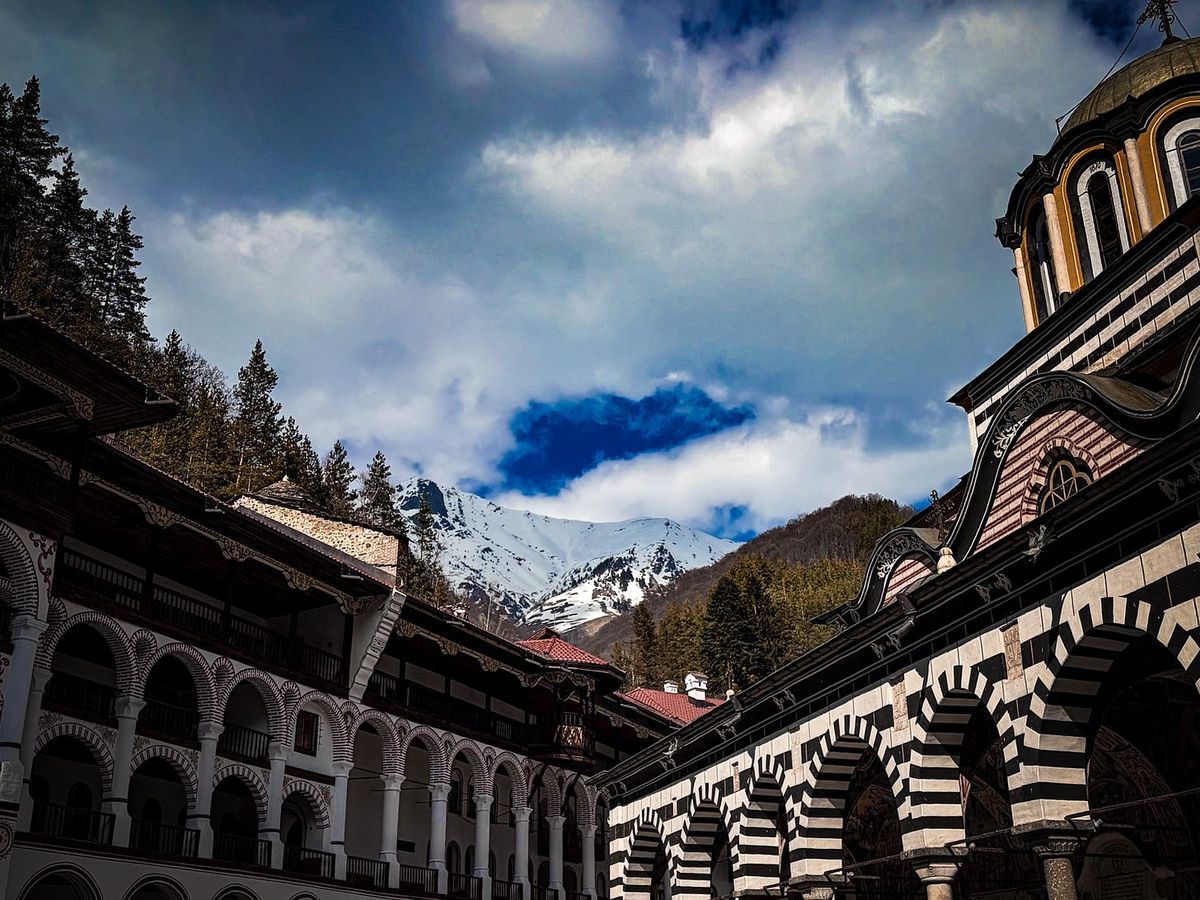
So note for next time: the drive south from Sofia towards Rila takes you along the motorway in the direction of the mountains, and it is, quite frankly, a pleasure. I visited in March, which I’d tentatively suggest is an underrated time to come. The crowds hadn’t yet materialised, the air had a crisp bite to it, and somewhere in the middle distance the peaks above Borovets were still snow-capped — visible from the road in a way that felt almost unfairly cinematic.
What You Actually Find When You Get There
First things first: Rila is in remarkably good shape for a monastery founded in the tenth century. The reason, I came to understand, is that this isn’t a preserved relic. It’s a living institution. Monks still live here. Services still take place. The maintenance and care that comes with a genuinely active religious community gives the place a quality that mere preservation rarely achieves. It is not a museum pretending to be holy. It is the opposite.
The setting is the first thing that hits you. The monastery sits in a valley folded into the Rila Mountains, surrounded by tall spruce trees and the sound of the Rilska River running nearby. It is the kind of place that would look implausible on a postcard. The walls of the main courtyard are striped in black and white arches, and above them rise domes and belfries that seem too elaborate, too confident, for somewhere this tucked away from the world.
Then you look at the frescoes, and something shifts. I’m not a religious person, and I say that not as a caveat but as a data point: if the frescoes at Rila can stop someone like me in their tracks, they will stop you too. They cover every surface of the covered walkways — saints, demons, judgment scenes, biblical narratives rendered in deep reds and cobalt blues that have held their colour for centuries. The detail is astonishing. The scale is overwhelming. Standing beneath them, you don’t need to believe in anything to understand that the people who made these believed in everything.
Lunch at Valyavitsa — Do Not Skip This
A short walk from the monastery, Restaurant Valyavitsa sits in the kind of setting that makes you briefly consider abandoning your previous life choices and moving to rural Bulgaria permanently. The food is Bulgarian mountain cooking: simple, seasonal, made with actual care. I had the chicken sach — a dish cooked and served in a shallow clay pan — with their home-made herby bread on the side ‘for dipping’. It was phenomenal.
The price, by western European standards, is almost comically reasonable. The service is warm without being performative. The setting — wooden beams, mountain views, the particular quality of Bulgarian afternoon light — does a great deal of the work. But the food does the rest. I would return to Rila specifically to eat here again, which is possibly the highest compliment I know how to pay a restaurant!
The Practical Bit
Rila Monastery is roughly 120km south of Sofia, about two hours by car via the A2/E79 motorway. Hiring a car in Sofia is straightforward and gives you the freedom to stop for photographs on the way, arrive when the tours haven’t yet, and linger for as long as the frescoes demand. If you’re set on a guided experience, the GetMyGuide options are competent and affordable — just be aware that time at the site is limited, and if the museums are on your list, push to arrive early or ask your operator in advance.
Admission to the monastery complex itself is free. There is a small charge for the museums. Go anyway. Take cash. And while you’re there, remember that you are in an active place of worship. Dress accordingly, speak quietly, and take a moment — whether you’re religious or not — to simply stand still and look up.
On the map
Interests